

How Forter Rebuilt Their Entire Territory and Account Strategy Using AI
A step-by-step look at how Forter built their first-ever ICP, assigned 65,000 accounts, and delivered a global territory model in six weeks

Every year, go-to-market teams go through the same painful ritual: spreadsheets, arguments, guesswork, and a territory plan that nobody fully trusts. I sat down with the GTM team at Forter to understand how they used AI to completely reimagine their territory planning process. Forter is a global fraud prevention platform serving 500,000 merchants and 2B consumers, processing $500B GMV in 2025 alone.
I spoke with Ozge Ozcan, CRO; Parker Tipton, Head of Field Ops; Gabby Upson, RevOps; and Kris Alspach, Head of Revenue Operations, about the challenge they faced, what they built, and what it means for anyone trying to scale a GTM operation with a lean team.
The Problem: A Global Business Without a Defined ICP
When Ozge took the CRO role, and Forter appointed its new CMO, Jason Grunberg, they started to assess foundational components of the company’s GTM strategy:
Where are we actually winning?
And how can we better align our Sales, Customer, and Marketing teams to accelerate growth?
“It has been a while since we took a step back and asked what are our ICP win rates,” Ozge told me. “Where are we winning? Where are we experimenting? And where are we not winning, but we think we are — because of research bias?”
Kris, who joined in October, walked into the middle of annual planning and quickly recognized the gap. “This is a global business, and we haven’t defined the ICP,” he said. “Territory carving strategy didn’t exist before Parker and Gabby started this initiative.”
Parker added: “ICP was insider knowledge, not a system. Territory design was a manual process and trust within the organization had really eroded.”
The data situation was just as fraught. Forter’s thousands of accounts lived across disparate systems. Industry classifications had ballooned to 65+ variations. Revenue banding came from conflicting sources. And the enrichment tool they were relying on — SimilarWeb — was only covering a small fraction of all accounts, leaving a sizeable account gap with no data at all.
And the timing? They discovered all of this in the second half of the year, with annual planning deadlines looming. Territories needed to be delivered in three weeks.
What They Were Doing Before
Before this project, Gabby had owned the territory process for nearly three years. “I don’t know if I would even call it a process. Territories were ad hoc — when reps needed their books replenished, when someone was dissatisfied, when we had new headcount. It wasn’t a process.”
The workflow was entirely spreadsheet-based. Each time something changed, a new spreadsheet got created. There was no scoring model, no defensible assignment logic, no global consistency across Americas, EMEA, and APAC. Reps didn’t trust their territories, and the RevOps team spent enormous amounts of time manually rebalancing account lists without being able to clearly explain the reasoning behind decisions.
“It was always a new spreadsheet every single time one thing changed,” Gabby said. “Messy, challenging, always ad hoc.”
How They Built an AI-Powered Territory Planning Workflow
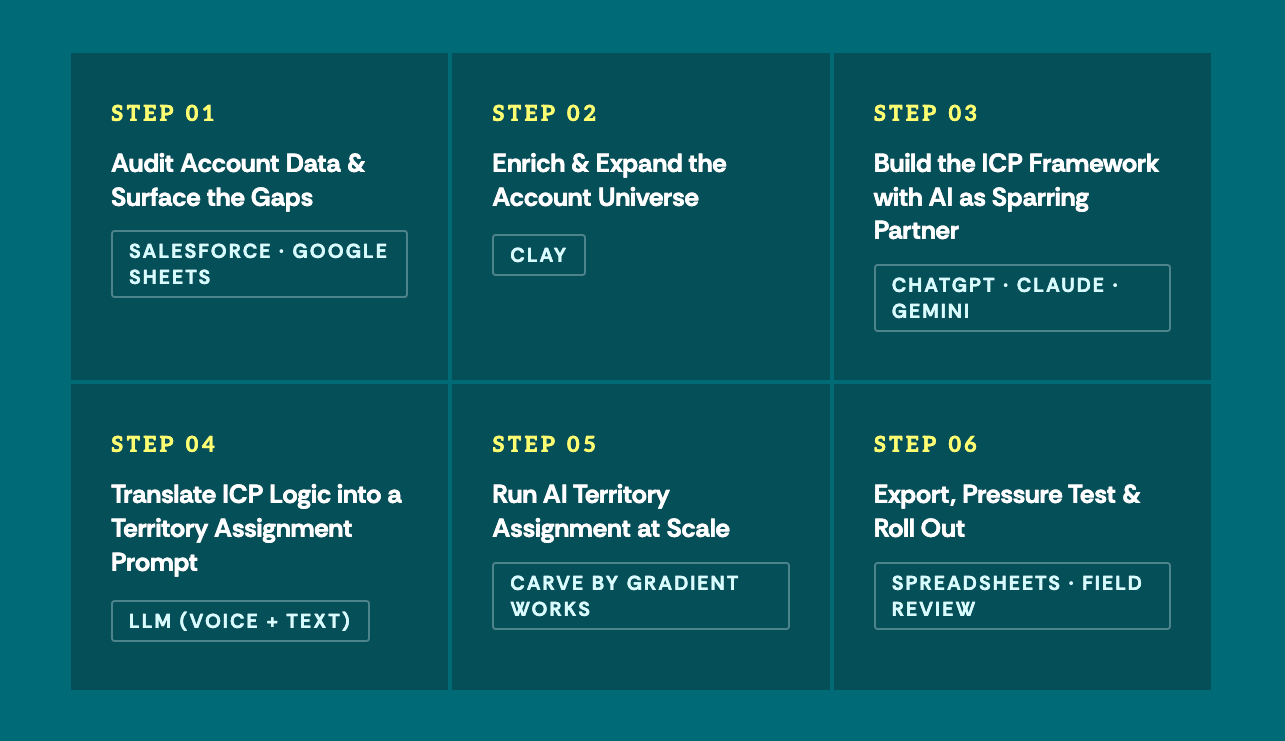
What Parker and Gabby built over the next several weeks was a fully AI-assisted ICP and territory design process. Here’s exactly how they did it.
Step 1: Pull All Account Data and Audit the Gaps
The first move was getting everything out of Salesforce and into a working environment to understand the true state of their data. This wasn’t glamorous work — it was pulling CSVs, running analysis in Google Sheets, and mapping what they actually had versus what they needed.
“The first phase really showed us where our data inequalities were and where the gaps were,” Parker explained. The gaps were significant: inconsistent industry classifications (65+ variations), unreliable revenue banding from multiple conflicting sources, and missing e-commerce GMV data — a critical metric for a fraud prevention platform focused on transactions.
Step 2: Enrich the Data with Clay
To close those gaps, the team brought in Clay, an AI-powered data enrichment platform. They integrated Clay directly with Salesforce, pulling their entire account base in to identify and fill the missing fields.
“Clay was a really big factor for us,” Parker said. “We pulled down our entire account base and used Clay’s data providers to fill the missing space — annual revenue, GMV data, employee counts — things that were all over the place or nonexistent.”
But Clay didn’t just clean the existing list. Once they had a clearer ICP definition (more on that below), they fed those criteria into Clay to find net-new accounts that matched the profile — adding several thousand accounts to their universe. “Now we have net new accounts that we did not have in our CRM that we can now target,” Parker said.
Step 3: Build the ICP Framework — with AI as a Sparring Partner
The ICP analysis itself was primarily a manual, collaborative effort between Parker, Gabby, finance, and GTM leadership. But they used general-purpose LLMs — ChatGPT, Claude, Gemini — throughout the process as what Parker called a “sparring partner.”
“We used AI for strategic reasoning — to pressure test what we were actually thinking,” he explained. “It could come up with different analysis or different thoughts that maybe we weren’t considering, or flag when we weren’t looking at the data in a specific way.”
The output was a tiered ICP: a primary target profile and a secondary profile, defined by industry, revenue band, GMV potential, and historical win rates. This was something the company had never had before in a codified form.
Step 4: Use a General LLM to Build the Territory Assignment Prompt
Rather than writing complex territory logic from scratch, Parker uploaded all of their ICP rules, quota coverage requirements, and territory classification criteria to an LLM and used a conversational back-and-forth — often via voice, not just typing — to synthesize everything into a single structured prompt.
“I try and use the conversation piece as much as possible — talking back and forth rather than typing,” Parker said. “I find it quicker, easier, and I can multitask. Even walking the dog, I’m still working.”
The prompt that came out was extensive — covering ACV/quota coverage thresholds, enterprise vs. strategic segmentation, ICP tier weighting, acceptable territory size ranges, and regional classifications for North America, EMEA, and APAC. “This would take a human being an incredibly long time to write,” Parker said. “Using tools like this, it takes me seconds.”
He also noted something that surprised the team: “I didn’t even have to explain what Carve was to the LLM. I just said, ‘We’re using a tool called Carve.’ It already knew exactly what it does and built the prompt for it.”
Step 5: Run Territory Assignment in Carve (by Gradient Works)
Carve, an AI-powered territory design tool from Gradient Works (and also a Stage 2 Portfolio company), is where everything came together. The team uploaded their enriched account CSV, fed in the prompt from Step 4, and let Carve do what would have taken days of manual work.
Here’s how Carve works in practice:
Upload your data. Bring in a CSV of your account universe (or connect directly via Salesforce integration). Define what each column means so the AI understands your schema.
Feed in your prompt. Paste in the territory logic you developed with your LLM in Step 4. Carve accepts plain natural language — no special formatting required. Gabby noted she wrote prompts “in all lowercase letters” and the tool responded correctly.
Run multiple scenarios simultaneously. You can test different territory configurations against the same data set — adjusting coverage thresholds, adding geographies, creating “to-be-hired” patches — and see how the outcomes differ without doing any manual work.
Ask exploratory questions about your data. Query conversationally: “How many apparel accounts do we have in Washington State?” This was especially valuable for answering ad hoc strategy questions from leadership without spinning up a new analysis each time.
Review AI-generated assignment explanations. Every account assignment comes with a clear rationale — “Assigned to [rep]: Geo = Enterprise East, Industry = Retail” — so you can answer rep questions and address challenges quickly and with confidence.
One dynamic the team found particularly interesting: as Parker and Gabby each ran separate projects within Carve, the tool got progressively smarter. “The questions it was asking from Gabby’s first build to my second build were much more robust and quicker,” Parker said. “It’s educating itself as we work together as a team.”
It also builds in human judgment checkpoints — surfacing ambiguous cases and asking the user to decide rather than auto-assigning — which is a meaningful trust feature. I especially like how it asks you — ‘I can make this decision, or do you want to?’ giving the human the extra reassurance and control.
Step 6: Export, Pressure Test, and Roll Out with Data-Backed Explanations
Once territories were built in Carve, the team exported results back to spreadsheets, added visuals, and brought them to leadership and the field. Because every assignment came with an AI-generated explanation, they were able to answer rep questions and address the inevitable reactions to territory changes far more efficiently than in past cycles.
“There is the analytics part of getting territories right, and then there is the emotional part,” Ozge reflected. “Having the data to explain the logic is incredibly difficult when you’ve spent days in a spreadsheet and lost the thread of why you made each decision. The team was able to answer questions much more rapidly with the AI tool.”
The Results
The numbers are striking for what a two-person RevOps team delivered:
65,000+ accounts enriched, scored, and assigned with defensible, explainable logic
First-ever codified ICP at a company with sizable revenue and customer base
First true territory model with geo-based logic, segmentation rules, and global consistency across Americas, EMEA, and APAC
15x quota coverage target achieved across all account books, with documented rationale for every assignment
Delivered in approximately 6 weeks against a hard annual planning deadline
“For a two-person team like Gabby and myself, we can now do things at a level and scale that would usually take a 5, 6, or 7-person RevOps organization,” Parker said.
To put it in perspective, when I was leading teams of 600 people, territories and assignments would take us a couple of months and three people just to build the analysis and show the data to managers, so everyone felt comfortable that the opportunity was distributed fairly. Seeing this — it’s crazy.
What’s Next for Forter’s AI-Powered GTM Stack
The team isn’t stopping here. Their next phase involves two major initiatives.
Intent Data with Common Room. Parker described rolling out Common Room post-SKO to surface account-level intent signals for sellers, connected directly to SalesLoft for outreach and Salesforce as the system of record. Reps will see a composite “BIT” score — combining ICP fit and intent signals — so that when they log in each morning, the highest-priority accounts are surfaced immediately.
AI-Powered Win-Loss Analysis. Ozge’s next initiative is to run a deep win-loss analysis using existing data — without requiring field interviews. She acknowledged the prerequisite challenge: building a culture where customer call recordings in Gong or Zoom are treated as strategic competitive assets rather than surveillance.
“Customer calls and conversations are now my competitive advantage data points,” she said. “That’s a mindset shift for the field — and it’s the next hurdle we need to go through.”
Three Lessons for GTM Leaders
1. Clean data is a prerequisite, not an outcome. AI amplifies what you have. The team’s first investment was in data quality — and it unlocked everything that followed. If your data is broken, the AI output will be too.
2. A defined process beats a smarter tool. You need data that’s accurate and a workflow or process already outlined. AI doesn’t just come in and do all those things for you. The ICP framework gave Carve the rules it needed to make meaningful decisions.
3. Use LLMs as thinking partners, not just execution tools. Some of the most valuable AI use in this workflow wasn’t automation — it was using ChatGPT, Claude, or Gemini to pressure test assumptions, identify gaps in reasoning, and translate complex business logic into a clean, structured prompt. That’s a skill every RevOps leader should develop.
 |
|