

Driving Awareness with Answer Engine Optimization with Sydney Sloan, CMO Advisor to G2
Why buyer discovery is shifting from search engines to AI answers, and what Answer Engine Optimization means for modern go-to-market teams

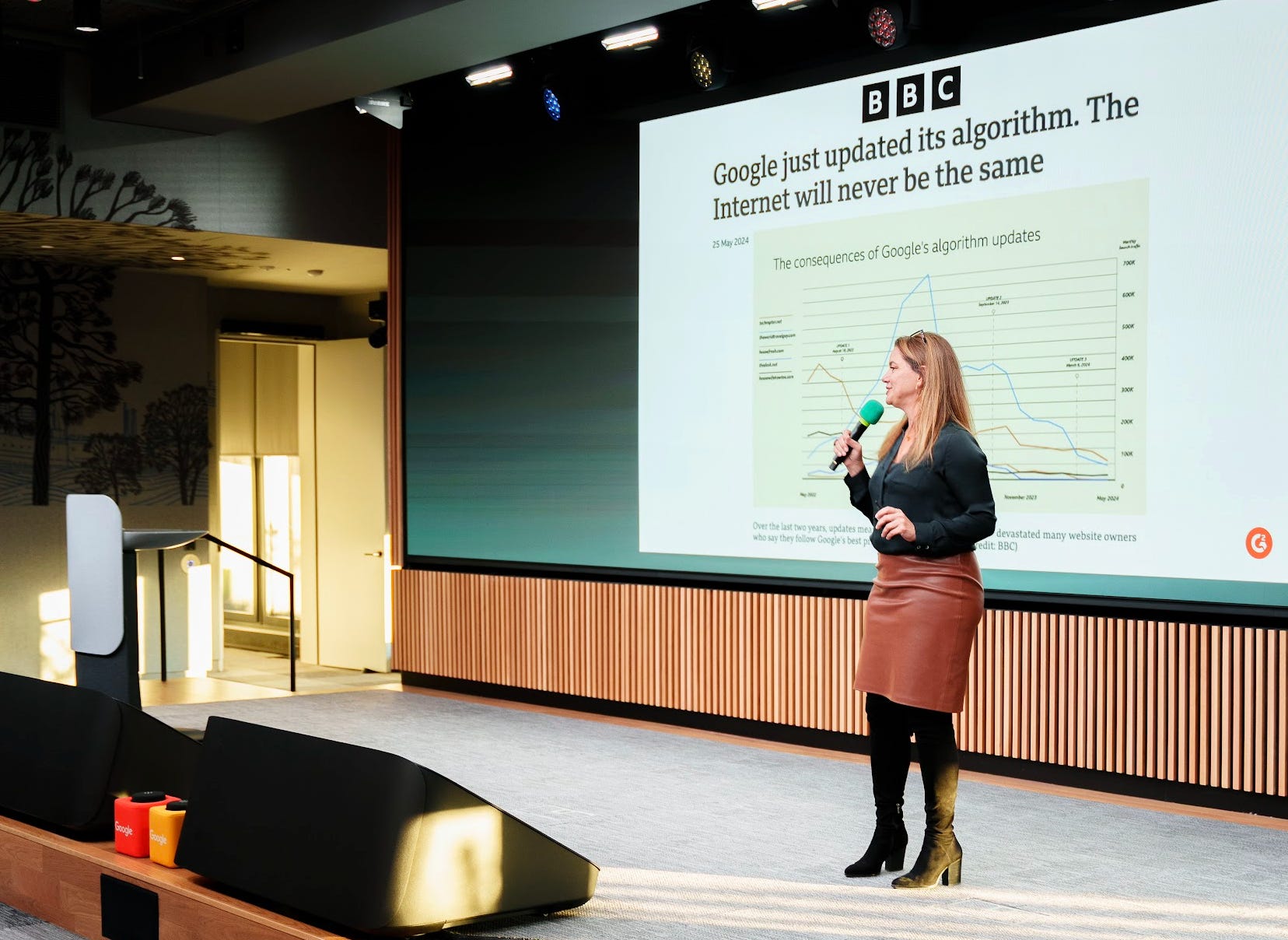
For years, go-to-market strategy assumed a relatively stable buyer entry point: search.
Founders invested in SEO, content teams optimized for keywords, and awareness was measured in rankings and clicks. That model quietly broke.
At the Stage 2 Capital Summit, Sydney Sloan, CMO Advisor to G2, laid out why we are now in a different era entirely. Buyers increasingly begin their journeys inside large language models, not search engines, where visibility is determined not by who ranks, but by who gets cited.
This shift has implications well beyond marketing. It changes how companies build awareness, how trust is established, and how early-stage GTM strategy must evolve in an AI-mediated buying environment.
What follows are five themes from Sydney’s talk that every founder, revenue leader, and marketer should be internalizing now
1. Buyers Are No Longer Starting with Search, They’re Starting with Answers
The most important insight from Sydney’s talk is also the simplest: buyer behavior has changed, and it changed fast.
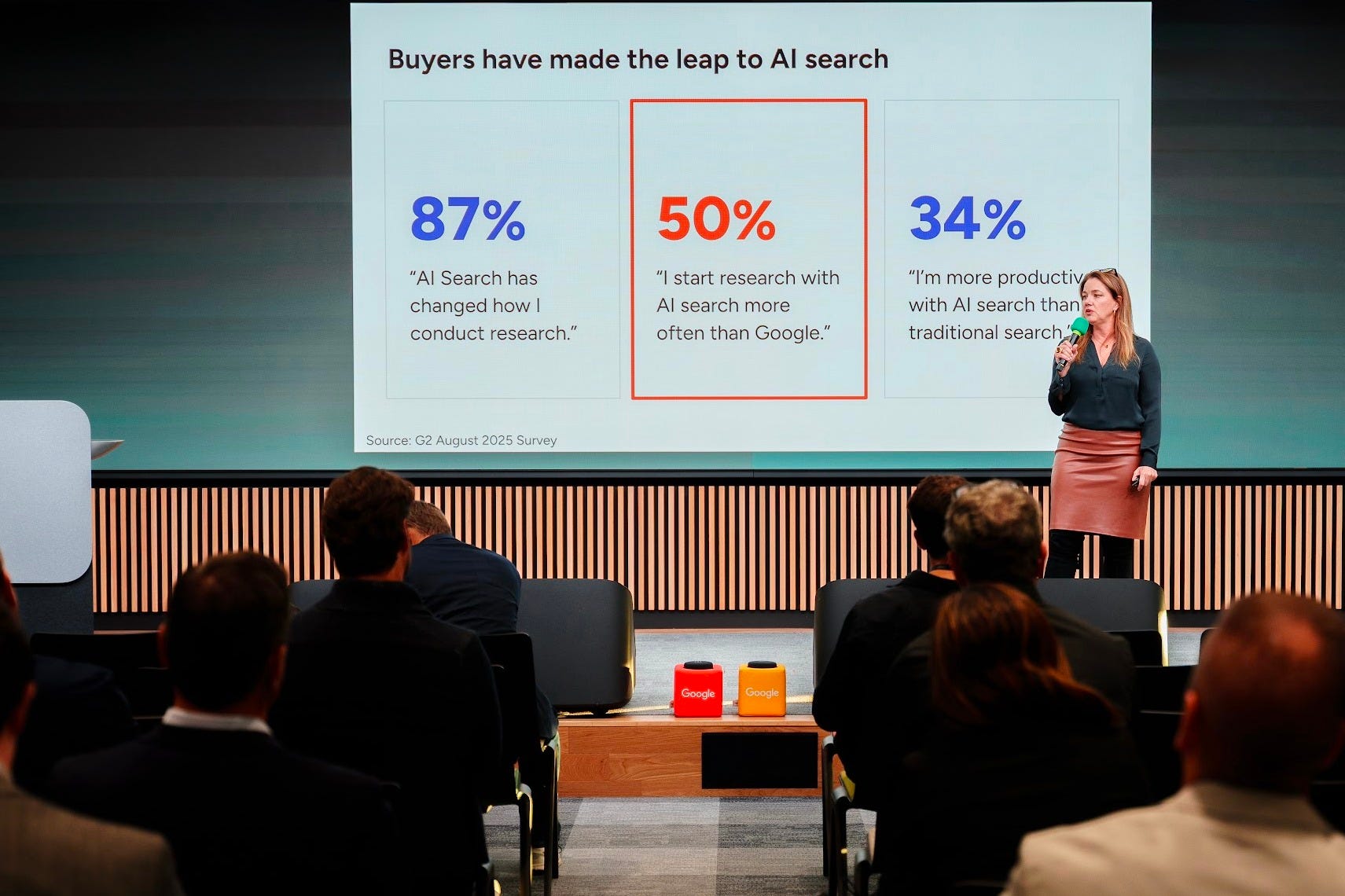
“In August, 50% of buyers said they start their search on an LLM,” she said. “In April, that was 29%. In four months, that changed 71%.”
This is not a marginal shift. Buyers are no longer discovering products by typing keywords into Google and clicking through content. They are asking LLMs complex, contextual questions and expecting synthesized guidance.
From a GTM perspective, this matters because awareness is no longer driven by traffic alone. If your company does not appear in the answers buyers are receiving, you may never enter the consideration set at all.
2. The Objective Has Shifted from Winning the Click to Winning the Answer
Classic SEO was built around a clear goal: rank highly and earn the click. This is no longer sufficient.
“We’re moving from this era of ‘I need to win that click’ to actually winning the answer,” Sydney explained.
Answer engine optimization (AEO) reflects this shift. Rather than optimizing for individual keywords, companies must optimize for the questions buyers are asking, and for being included in the responses LLMs generate.
This reframes content strategy from a traffic exercise into a trust and relevance exercise. The question is no longer “How do we rank?” but “When buyers ask real questions, do we show up as part of the answer?”
3. AEO Is a Real Category, and It’s Forming at Breakneck Speed
Sydney was explicit in distinguishing between closely related terms: “AEO is about ensuring your product shows up when a question is being asked. GEO is about generating content.”
That distinction matters, especially given how quickly AEO has become its own category.
“In April there were seven vendors; now there are over 100,” Sydney said.
The speed of category formation signals both urgency and noise. For most companies, the opportunity is not to build tooling, but to understand how AEO fits into their broader GTM motion.
Founders should treat AEO the same way they once treated SEO: not as a tactic, but as infrastructure for awareness in the dominant discovery channel of the moment.
4. LLMs Reward Consensus, Not Isolated Optimization
One of the most operationally important insights in Sydney’s talk is how LLMs actually determine what they surface.
“LLMs work on consensus,” Sydney said.
LLMs scan across many sources to determine the most consistent, credible answer. That means visibility is no longer driven by a single high-ranking page, but by coherence across your entire digital footprint.
“You want to ensure your content is consistent,” she said. “This includes how you describe yourself on your website, in partner portals, on G2.”
From a GTM standpoint, this pushes companies toward a more integrated view of brand, content, reviews, and distribution. Inconsistent positioning across channels does not just confuse buyers; it reduces the likelihood that LLMs will surface you at all.
5. Awareness in the AI Era Is Built on Breadth, Consistency, and Human Language
Finally, Sydney emphasized that AEO is not about gaming a new algorithm. It is about answering real buyer questions clearly and consistently, in human language, across many surfaces.
She encouraged teams to build content around personas and jobs-to-be-done, even when that content does not directly promote the product.
“Even if it’s not what you do, that’s how you build your brand,” Sydney said.
This mirrors what we see repeatedly in successful GTM strategies: durable awareness comes from being genuinely helpful before it comes from being persuasive.
What This Means for Go-To-Market Leaders
AEO is not just a marketing concern. It sits upstream of pipeline, influencing which vendors buyers ever learn about in the first place.
As AI becomes the default interface for research and discovery, go-to-market teams must rethink how awareness is earned. Winning in this environment requires:
Understanding the real questions buyers are asking
Ensuring consistent positioning across owned and third-party channels
Investing in breadth, credibility, and distribution, not just rankings
As Sydney put it:
“There is no playbook. You just have to stay in the playground.”
For founders and operators building in this moment, AEO is quickly becoming a core GTM capability, not because it is new, but because buyer behavior has already moved on.
 |
|