

Anyone Can Accomplish 3 Things in 3 Months
A CEO’s guide to (ruthless) prioritization and finding the real blockers

DEAR STAGE 2: My company is bigger than it was last year, and now I’m stretched thin. There are more responsibilities, more people wanting my time, and I feel overwhelmed. I’m worried I’m not focusing on the highest-impact work. How do I figure out what actually deserves my attention? ~CEO LOOKING AHEAD
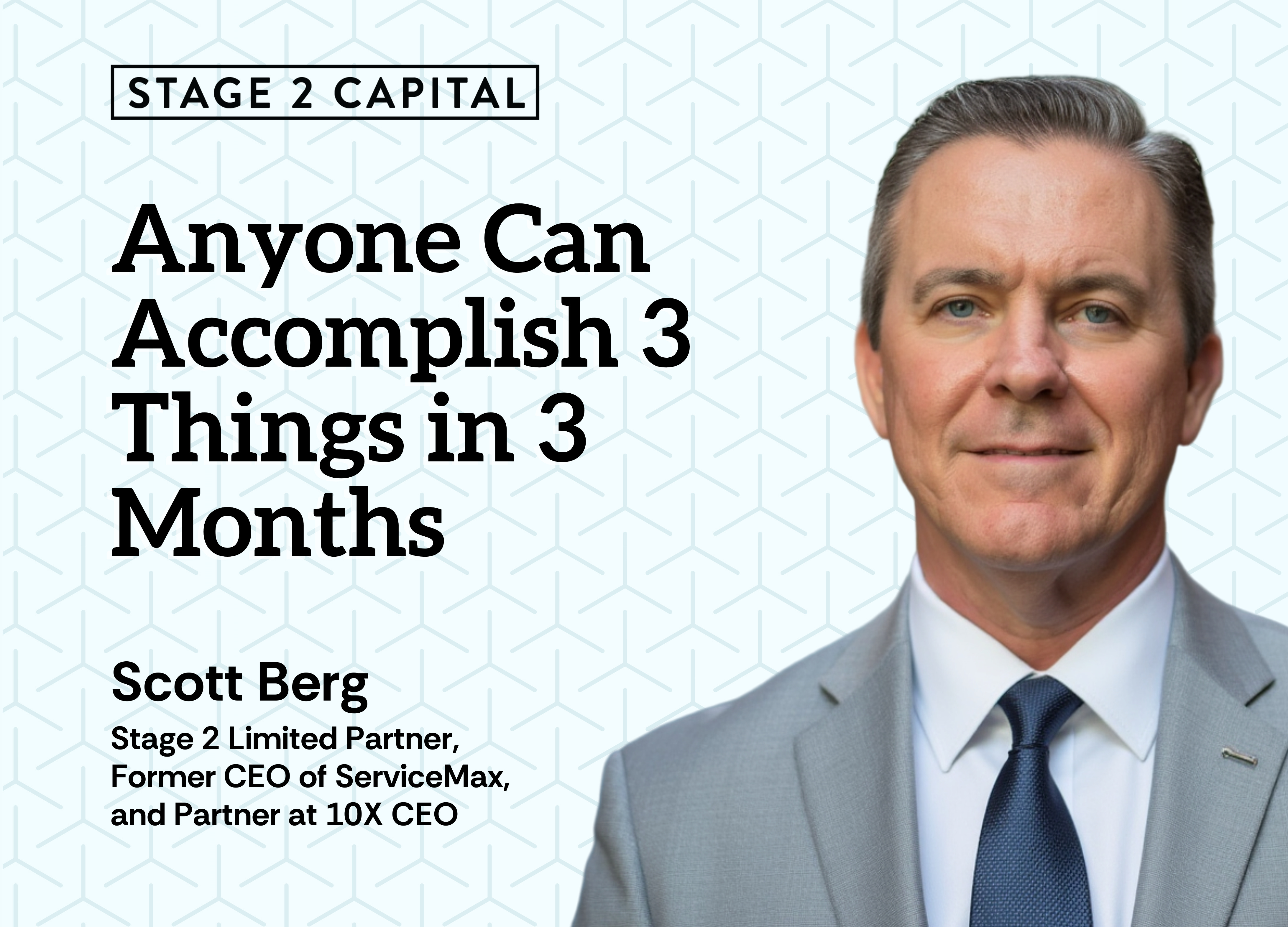
DEAR CEO LOOKING AHEAD: A startup CEO has the loneliest job in the company. When your company is growing fast, the job you had last year isn’t the job you have now. It’s important to zoom out and ensure you are focused on the right initiatives. Easier said than done.
I turned to Scott Berg for advice on evolving as a CEO during crucial growth periods. Scott is the former CEO of ServiceMax, a Stage 2 Capital LP, and a Partner at 10X CEO, a leadership program where he’s coached over a hundred venture-backed CEOs. Here’s Scott’s advice for avoiding the “busy trap” and making sure your time is pointed at what matters.
He started by sharing his thought process behind “3 Leveraged Priorities”. To paraphrase: anyone can accomplish 3 things in 3 months. The challenge lies in choosing the right 3 things, removing the primary constraint, and doing only the things a CEO could do.
Take a look at your own priorities through this lens:
1. Re-center on the Picture of the Future
The biggest mistake founders make as they scale? They stop pausing to ask: What am I actually building?
Scott pushes his CEOs to write a “picture of the future,” a 3-year vision that’s clear, specific, and revisited multiple times a year. Not a mission statement. A press-release-style summary of what success actually looks like. Think: “We’ll be the #1 provider of XYZ, touching 30% of global transactions over $5.”
You need to document this and revisit it quarterly. Why? Because without it, every day becomes about fire drills, not forward momentum. If you’re busy, but you’re off course, you’re just moving faster in the wrong direction.
2. Find the Kink in the Hose
Every startup has a primary constraint, the single biggest bottleneck that’s holding back growth.
Scott uses the “garden hose” metaphor: “You turn on the water, but nothing’s coming out. It’s not the faucet, it’s the kink.”
Your job as the CEO isn’t to solve every problem. It’s to solve the right one. You need to identify the kink that, if resolved, unlocks the most downstream impact. Don’t get distracted by noise. Focus your time on that single issue.
Examples of primary constraints:
You’ve got demand but can’t scale onboarding
Pipeline is strong, win rate is tanking
Product is sticky but no longer differentiated
Scott advised taking the time to reflect on this regularly and ensuring that you are ruthless about aligning your calendar around fixing it.
3. Set 3 Leverage Priorities (and Actually Do Them)
Most CEOs make two mistakes with goal setting: too many priorities, and not enough priority on things that solve my primary constraint. Scott asks the CEOs he coaches to set 3 quarterly “leverage priorities”. These are things that only the CEO can do. No delegation. No multi-part lists. Just 3 big swings.
Typical examples:
Making a critical exec hire
Leading a fundraising round
Fixing company narrative or market positioning
When you’re spending time on something that doesn’t map back to one of those three, stop and ask yourself why. Reclaim your time and reassign the task. Your job is to move these big boulders and surround yourself with a team that can manage the day to day.
If you do just one thing after reading this, block an hour this weekend to reflect and ask yourself these 3 questions:
What’s our 3-year picture?
What’s the ‘kink in the hose’?
What 3 things should I really be doing this quarter?
Then go do them. And protect your time like the company’s future depends on it (because it does).
Until next week!
✍🏽